

Written November 2023.
In November 2022, the launch of Chat-GPT marked a pivotal moment, significantly altering the operational landscape for both businesses and individuals. This groundbreaking development triggered a rush among businesses, all eager to harness the power of AI to gain a competitive edge. In response, a multitude of AI solutions emerged, each vying for attention. However, many of these offerings were superficial, often termed as 'candy wrapper solutions'—essentially just a fancy UI layered over a basic Chat-GPT API key with some pre-set prompts. Others took a more costly route, offering businesses pre-trained chatbots for their CRM systems or websites, but these too fell short, simply regurgitating company information without truly enhancing customer interaction or business processes. Among the flurry of these innovations, there were, of course, some serious and valuable AI solutions. These, however, were typically tailored for very niche industry needs.
My research into the AI landscape highlighted a significant market gap: the lack of a comprehensive, versatile AI solution suitable for a broad range of businesses, startups, freelancers, and individuals. This gap was emphasized by the common challenges these groups face, including struggles with managing workloads, optimizing workflows for increased efficiency and productivity, a lack of specialized expertise due to resource limitations, and difficulties in managing complex projects, particularly with remote teams. Despite the variety of options available, I did not find any solution that provided the all-encompassing functionality needed to address these requirements.
In March 2023, the AI world experienced a second wave of innovation, largely unnoticed except by a few niche groups, but this wave had the potential to fundamentally redefine what businesses and individuals could achieve with AI. This change was sparked by the release of BabyAgi and Auto-GPT as open-source code on GitHub, which represented a significant leap in AI capabilities.
What set these GPTs apart was their ability to function as autonomous agents on assigned projects. They were capable of autonomously writing and revising sub-tasks, continually prompting themselves until a project reached completion. Additionally, these GPTs had an effective feedback loop, enabling them to adapt and pivot within a project based on self-generated feedback. Perhaps most intriguing was their potential for cognitive development, suggesting an evolving understanding of the world over time.
This advancement was notable because it removed the burden on users to constantly think of the next steps or craft the perfect prompts for AI to produce the best outcomes. These GPTs could independently conceptualize and execute large-scale projects with minimal or zero human intervention, a significant upgrade from what was previously available to the public. However, I recognized a limitation: they were still essentially text-based bots.
This realization led me to ask myself, “What if their capabilities extended beyond text?” The implications of this thought were both astonishing and somewhat daunting, as it hinted at the possibility of a major shift in the global economy and the potential displacement of millions of jobs. Despite this, I was reminded of the current sentiment around the persistent search for an effective solution, which only fueled my curiosity about the nature and potential of such a solution.
From this curiosity emerged the concept of my new project, Creci. Creci stands out due to its unique functionality, encompassing a range of features designed to enhance the AI experience in business environments. These include:
I discovered that each of these features and APIs already existed as open-source code on GitHub. However, their true potential remained untapped, as they existed in isolation from each other. No existing solution had yet integrated these systems into a cohesive platform. Recognizing this gap, I viewed Creci not as a theoretical concept but as a concrete, achievable possibility. So I began exploring this further.
%201.png)
%201.png)
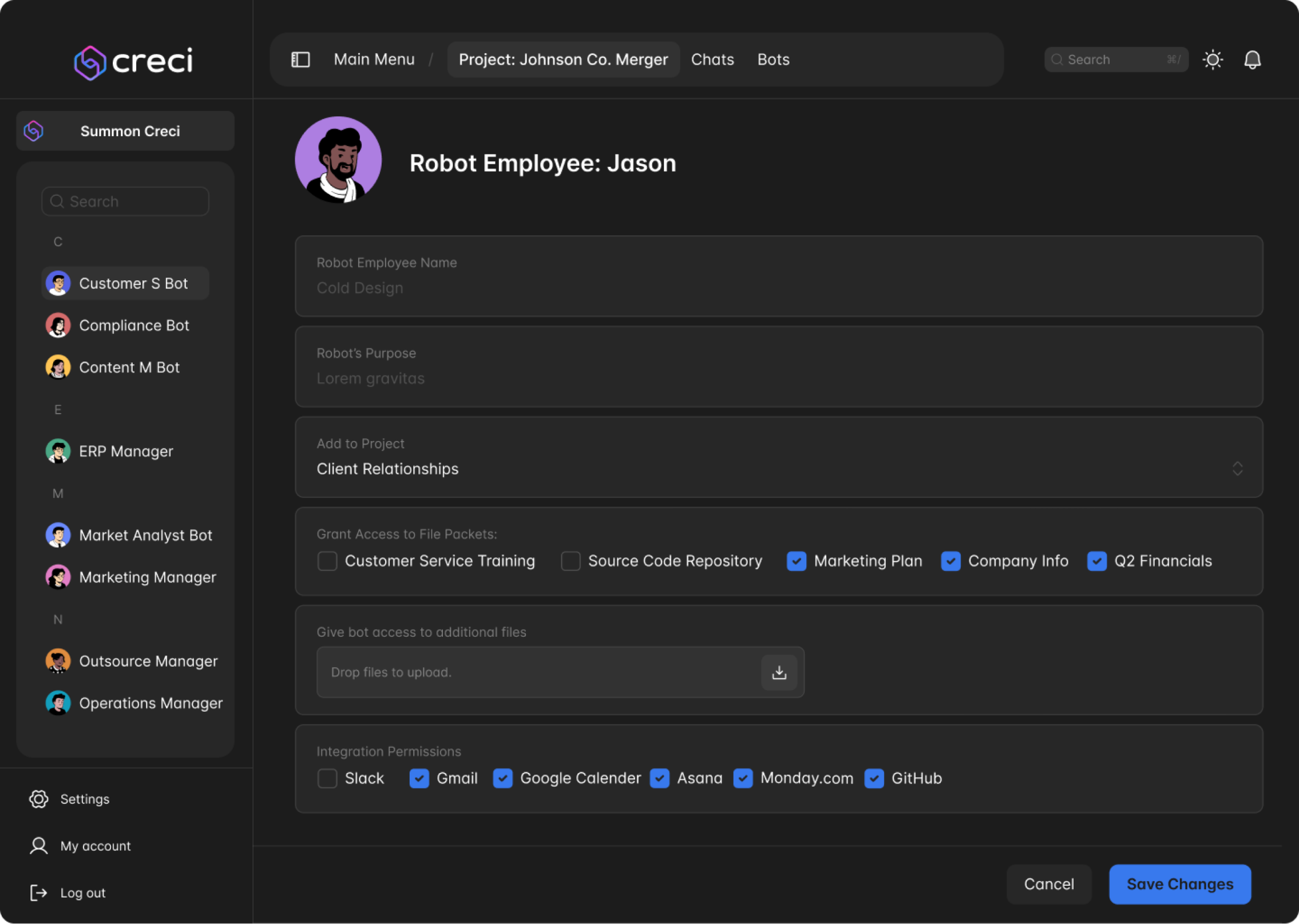
Users have the flexibility to upload various file formats for training bots, with the option to seamlessly link them to a database of company information as needed. Account admins and designated managers can grant bots access to secure file libraries in their company database. This instant access not only equips the bots with crucial context about the company's guidelines, protocols, and restrictions but also extends to uploading code repositories, financial records, industry-specific textbooks, and manuals, essentially enabling the AI to learn from any material a human can. The AI agents are designed for ongoing learning and development. Through active engagement with industry and company standards, they adapt and evolve over time, improving efficiency and productivity based on user interactions and feedback. Creci also allows users to personalize bots with unique names, distinct personalities, and specific departmental roles.
In the B2B market, the integration of AI solutions within workflows and services is essential. Creci's agents meet this demand with a broad scope of capabilities. They are adept at navigating and optimizing CRMs and ERPs, managing supply chains, and handling customer leads and support. These agents are capable of interpreting real-time information and current events, making strategic pivots in response, while also providing insights and recommendations for your business.
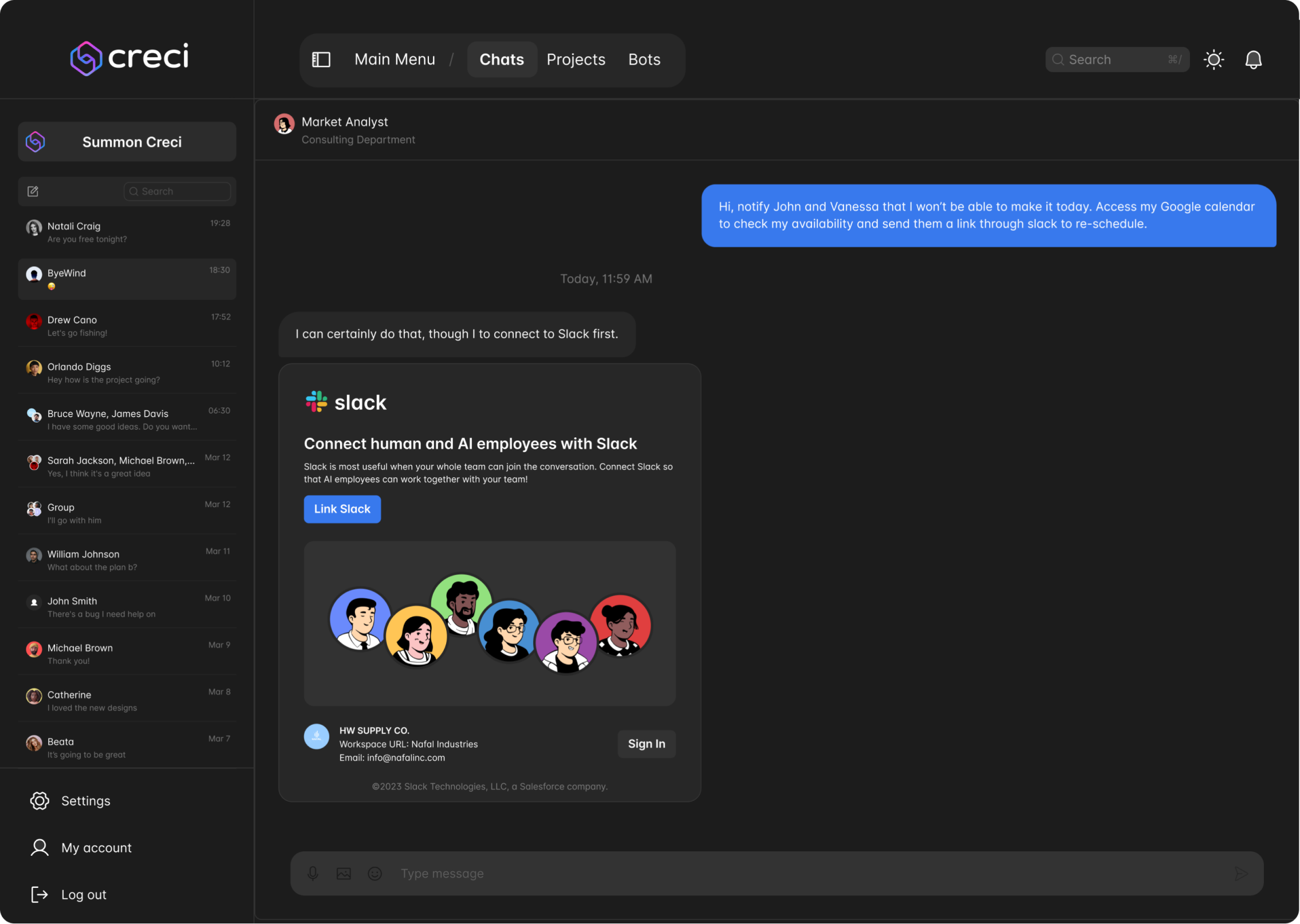
Their versatility extends to task management, where they facilitate effective collaboration with human employees and can autonomously handle tasks. As personal assistants, Creci's agents efficiently manage communications through Slack and Gmail and keep schedules organized using Google Calendar. These are just a few examples. The possibilities are truly endless and only limited by the availability of third-party API keys and one’s own imagination.
The significance and potential of HTML Parsing and interaction capabilities, which enable bots to read and interact with web pages, have seen a notable increase and are expected to continue evolving. With these advancements, it's conceivable that within the next 2-3 years, we could witness the integration of autonomous agents with enhanced HTML Parsing and interaction capabilities. This development would would allow AI bots to navigate and interact with the web and various applications to complete their assigned tasks. Achieving this milestone would mark a paradigm shift, as autonomous agents would transcend the limitations of API keys, opening up possibilities for them to perform a wide array of tasks on the web, mirroring human capabilities.
At the heart of our platform is 'Creci', an advanced AI assistant embodying high efficiency and versatility. Acting as both an assistant and a project manager, Creci has comprehensive access to all data trained by AI agents, enabling it to initiate, oversee, and manage extensive projects. This includes organizing teams, assigning tasks, scheduling appointments, sending emails on your behalf, and adjusting other AI 'employees' calendars to reflect current business needs. Creci's role extends to task creation and modification, both for itself and other AI 'employees', ensuring seamless communication and efficient information flow.
What sets Creci apart is its ability to take your ideas or project requirements and autonomously bring them to fruition. It can lead teams, and if needed, create new bots using permissible company data. This hands-off approach means you can instruct Creci to undertake significant projects, and it will manage all aspects from start to finish. Progress can be monitored via a CRM-like dashboard, providing a transparent view of the developments or you can directly ask Creci for updates.
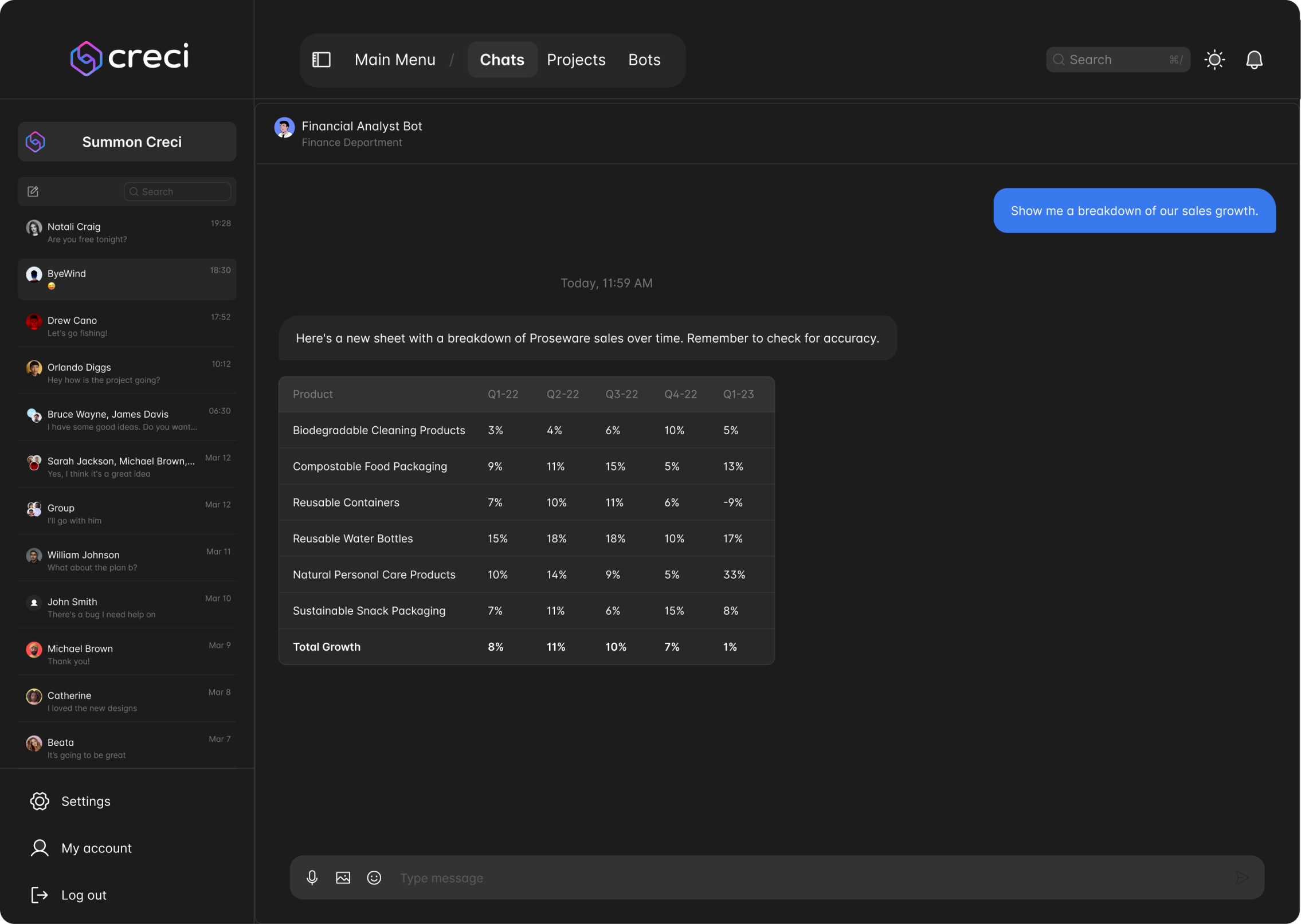
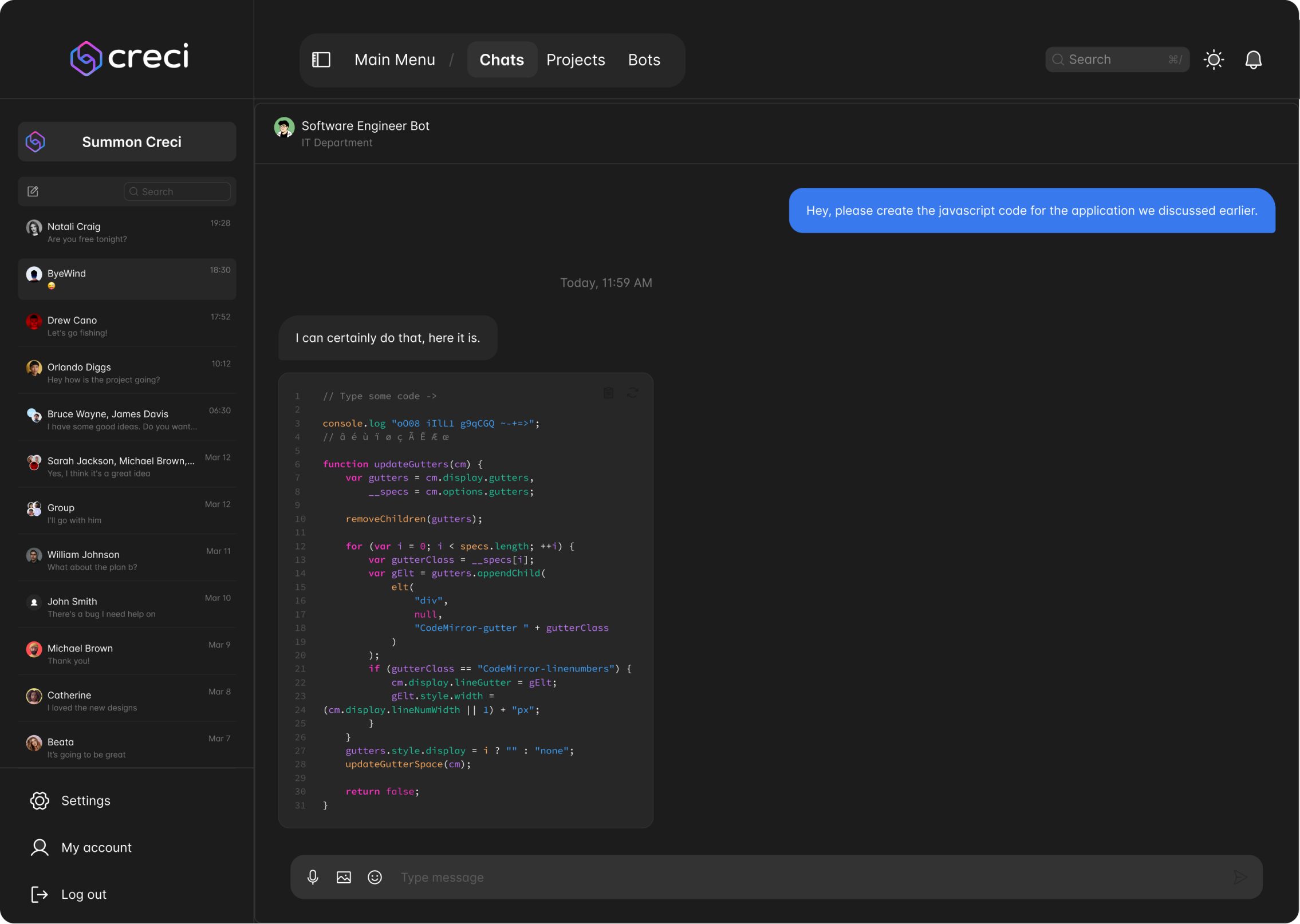
Moreover, Creci's capabilities include image generation and organizing reported information into accessible formats like PDF, Google Docs, or Excel files for download. One of the most innovative aspects is its coding ability; Creci can write code and collaborate with multiple AI agents specialized in various coding languages or computer science fields, continually expanding on codebases. These agents work in concert to produce a unified summary or 'deliverable' of the entire project, effectively consolidating the efforts of all AI workers involved. This functionality is applicable to any large-scale project or system maintenance, demonstrating Creci's ability to handle tasks of any size and complexity.
Creci offers the unique capability to run multiple specialized agents simultaneously, setting it apart from traditional chatbots. These agents are not only designed to communicate and exchange feedback with each other, thereby enhancing the overall quality and effectiveness of the solutions they develop, but they also work collaboratively on large-scale projects. This multi-agent approach allows for the simultaneous execution of numerous complex tasks, fostering an environment of shared insights and collective evolution, which in turn boosts overall output and efficiency.
Moreover, these agents are adept at collaborating with human employees who have access to the project, ensuring a harmonious blend of AI efficiency and human insight. Empirical evidence from the Massachusetts Institute of Technology's Computer Science and Artificial Intelligence Laboratory (MIT CSAIL) bolsters the effectiveness of this collaborative approach. Their research has shown that multiple AI systems engaging in discussions and debates can converge on the most accurate and effective solutions. This is achieved by allowing the systems to challenge each other's responses, thereby improving their adherence to factual data and sharpening their decision-making processes. Such an innovative multi-agent system represents a significant advancement in AI's capability to manage and execute versatile projects with sophistication and precision.
In designing Creci, my primary challenge was to align the platform's features with real business needs and use cases. This involved a careful selection process, where practical features were incorporated, and overly complex ones were set aside. My approach throughout this process was anchored in comprehensive technical research, combined with a commitment to efficient and agile development strategies.
A significant part of my work was dedicated to multiple UX/UI iterations, ensuring that the final designs were not only user-friendly but also functionally robust, effectively bridging the gap between advanced AI capabilities and practical usability.
The development of Creci was a meticulous blend of targeted feature selection, in-depth technical research, and iterative design refinement, all aimed at delivering a user-centric AI platform that resonates with real-world business applications.